Meaning. Examples. Equivalents in other languages.
Meaning
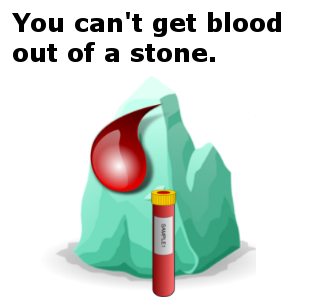
You can’t get blood out of a stone or You can’t get blood from a stone means that it is pointless to expect positive results from someone or something that doesn’t have the will, the ability or the resources.
Examples
Persuading Mary to come to the party is like getting blood from a stone.
Getting him to come clean is like trying to get blood out of a stone.
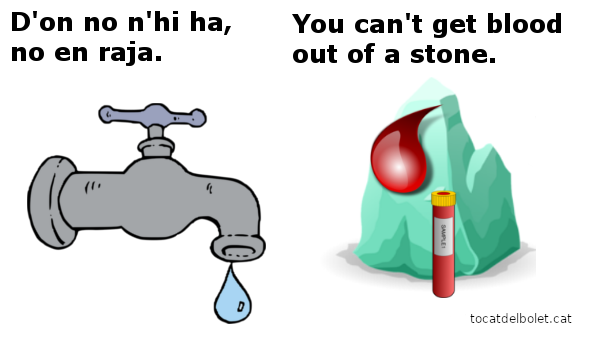
You can’t get blood out of a stone in Catalan
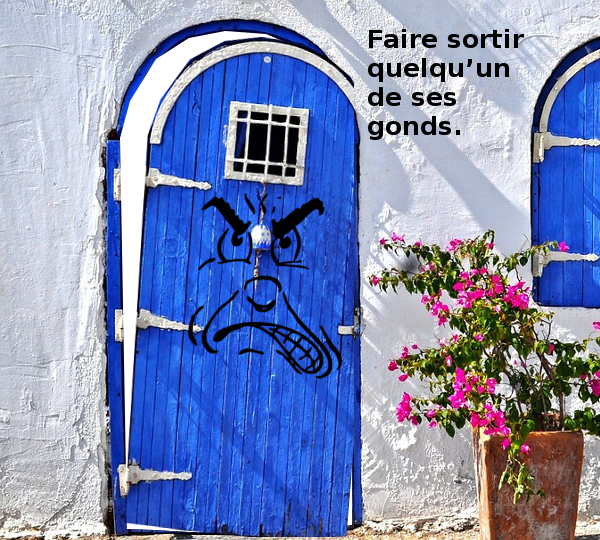
You can’t get blood out of a stone in French
C’est comme se heurter à un mur (literally, It’s like hitting your head against a wall).
You can’t get blood out of a stone in Irish Gaelic
Is doiligh olann a bhaint de ghabhar ( literally, it’s hard to get wool off a goat).
Nuts meaning, examples, synonyms. Nuts in other languages.
Meaning
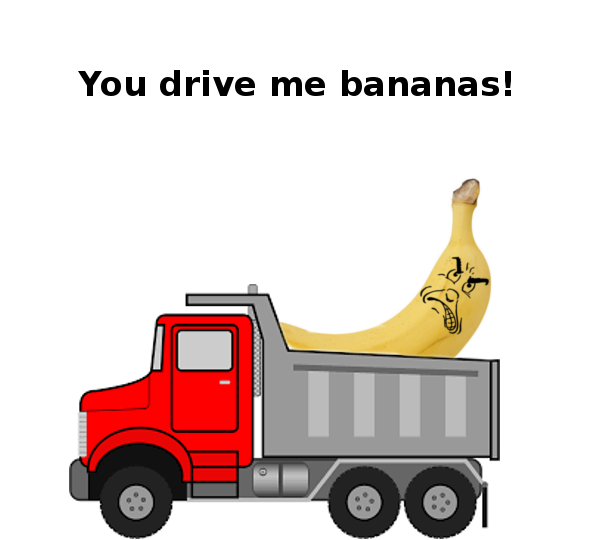
Nuts, in a figurative sense, means to be crazy or foolish. You can go nuts (go crazy) or something can drive you nuts (crazy). It also means to be very enthusiastic about something.
She went nuts when she won the lottery. He lost all the money just one year after.
I sometimes go nuts when people touch my stuff.
I’mnuts about boardgames, specially Settlers of Catan.
Nuts in Catalan
In Catalan you can say tocat del bolet (literally,touched by a mushroom) for Nuts or estar tocat del bolet for (to) be nuts. You can also say et falta un bull (literally, you lack a boil) or estàs com un llum (literally, you are like a light) or even estàs com una cabra (literally, you are like a goat).
Nuts in Basque language
In Basque language we have a number of choices: burutik eginda egon, (burutik) jota egon, (burutik) eraginda egon, (burutik) ondo egon ez, (burutik) sano egon ez, harrikadea euki/harrikada eduki (hum.), ganbaratik ondo egon ez (hum.), burua pitzatuta eduki, zoratuta egon.
Nuts in French
In French you can say complètement cinglé(e) o complètement à la masse. For example: Mon Dieu, il est complètement cinglé! (OMG, he’s gone completely nuts!)
Nuts in Italian
In Italian, there is the expression Passo. For instance, No, allora sì che crederanno davvero che sono pazzo (Now they will think that I’ve really gone nuts).
Nuts in Irish Gaelic
Depending on the context, in Irish Gaelic nuts can be:
as do mheabhair
craiceáilte
ar mire
bailithe
He’s completely nuts: tá sé glan as a mheabhair, tá sé iomlán craiceáilte, tá sé ar mire glan She went nuts: chaill sí an bloc, spréach sí, chuaigh sí ar mire It’s driving me nuts: tá sé do mo chur soir, tá sé do mo chur as mo mheabhair
Nuts in German
(to) be nuts in German is Spinnen (informal): (to) go nuts is durchdrehen or anfangen zu spinnen.
Nuts in Scottish Gaelic
In Scots Gaelic, Nuts is Cnóthan(as in nuts/bolts; walnuts etc.) As in crazy/nuts, craicte.
Nuts in Spanish
In Spanish you can say estar como un cencerro (literally, to be like a cowbell). You can also say chiflado (loony, whacky) or estar como unacabra (literally, to be like a goat).
(to) sleep like a log: meaning, synonyms, example and translations to other languages
Meaning
(to) sleep like a log means to sleep like a baby, like a rock, like a top… that is to say, to sleep heavily, long and without disturbance.
Example
You slept like a log. You didn’t even hear the storm.
(to) sleep like a log in Catalan
In Catalan you can say either Dormir com un tronc (literally, to sleep like a log) or Dormir com un soc (literally, to sleep like a stump). You can also say Dormir com un bebè (to sleep like a baby).
(to) sleep like a log in French
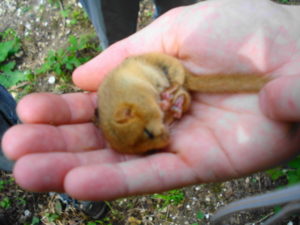
In French it is Dormir comme un loir (literally, to sleep like a dormouse). A dormouse is a rodent of the family Gliridae that likes sleeping very much.
Dormouse
(to) sleep like a log in Portuguese
In Portuguese, like in English, there is the idiom Dormir como uma pedra (literally, to sleep like a rock).
Dormir como uma pedra (Portuguese)
(to) sleep like a log in Spanish
In Spanish it is Dormir como un lirón (literally, to sleep like a dormouse) or Dormir como un ceporro (literally, to sleep like a fool). They also say Dormir como un bebé (to sleep like a baby)
Dormir como un lirón (Spanish)
(to) sleep like a log in Welsh
In Welsh it is Cysgu fel clawdd (literally, cover sleeping).
Thank you for visiting! We look forward to seeing you again.
Idioms ~That’s a different kettle of fish in other languages
Meaning
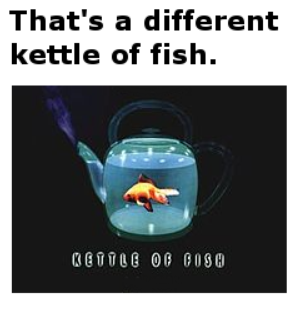
(to) be a different kettle of fish refers to a topic or situation which is enterily different from the one that was just being discussed. Synonym: It’s a horse of a different color.
Examples
… I suppose we could organize a party, but that’s an entirely different kettle of fish, we were discussing about the impact of the economic crisis on the labour market.
However, MPs are something of a different kettle of fish to the MEPs in my view.
That’s a different kettle of fish in Catalan
In Catalan there is the idiom Sónfigues d’un altre paner (literally, These are figs from another basket).
That’s a different kettle of fish in French
In French, the closest equivalent is Une autre paire de manches (literally, another pair of sleeves).
That’s a different kettle of fish in French: c’est une autre paire de manches.
That’s a different kettle of fish in German
In German it is ein ganz anderes Para Schuhe (literally, These are another pair of shoes).
That’s a different kettle of fish in Italian
Depending on the context, there are 3 versions in Italian, namely, la cosa cambia aspetto (literally, the thing changes of aspect) , è un altro paio di maniche (literally, that’s another pair of sleeves) o questo è ben altro affare (literally, That’s a completey different matter).
That’s a different kettle of fish in Spanish
In Spanish there is the idiom Eso es harina de otro costal (literally, this is flour from another sack/bag).
Nuts ~ Tocat del Bolet is a blog that aims to promote and share Catalan language and culture throughout its most typical expressions, in a fun and informative way.
Typical British expressions and their equivalent in Catalan language PART 2
Bones!
Welcome back! Here are 20 further common British English expressions translated to Catalan. As in the first part of Common BrE expressions translated to Catalan, they sound very idiomatic in both languages, so, again, if you ever go to the UK or Catalonia and use these expressions, you will probably impress locals.So let’s have a look at these new expressions:
(to) be stuffed
To be stuffed means to be very full. In Catalan language it can be translated as the very idiomatic expression estar tip, for example No en vull més. Estic tip (I’m good. I’m stuffed).
Estic tip
I’m gutted
I’m gutted means that I am very disappointed. In Catalan, you can say M’he quedat xof / Estic decebut/da.
I’m gutted
(To) be in a pickle
It means (to) be in a difficult or confused situation. In Catalan Estar (ficat) en un merder / embolic.
I’m in a pickle.
That’s mental / It’s mental
Something is crazy or surprising. In Catalan És de bojos (to say that something is a madness) or Quina passada or Brutal (for a surprising thing) depending on the context..
It’s mental!
Give me a bell
It basically means Get in touch with me or Call me. Very similar to the expression we saw in the first part Give me a tinkle (on the blower)> In Catalan, you can say Fes-me un truc or just Truca’m (Call me).
Give me a bell
(to) be in a mood
It means (to) be in a bad mood / upset. In Catalan slang you can say Estar ratllat. In a colloquial language you can say No estar del tot fi/fina or Estar de mala lluna.
I’m in a mood
Crickey / Blimey
It is an expressions to show shock or surprise. In Catalan, you can say Ostres!, ospa! (this one quite provincial), Caram! or, in slang language Wala! (this one quite urban).
(to) take the mickey out of someone
It means to make a joke about someone or to tease them. You are taking the mickey out of me. In Catalan You are taking the mickey out of me can be translated as Em fots el pèl or Me l’estàs fotent.
He’s taking the mickey out of us.
(to) pull someone’s leg
Very similar to make the mickey out of someone. This somewhat old-fashioned expression means to make a joke about someone or to tease them. In Catalan Prendre / fotre el pèl.
(to) faff about / around
We are constantly doing it, specially with social networks. Waffing about or around means to waste time doing unimportant tasks instead of the thing that one should be doing. In Catalan you can say Fer el dropo or Perdre / Matar el temps.
(to) lose the plot
(to) Lose the plot means (to) become confused / (to) do something crazy. In Catalan you can say anar-se’n l’olla. Se m’ha anat l’olla (I lost the plot).
I’ve lost the plot
That’s crap
Slang. You wouldn’t use it in a formal situation. You use it to say that something is not good, that something is rubbish, of low quality. In Catalan you can say És una merda or de merda (if it works as an adjective). For instance una peli de merda (A crap movie). We love the expression Una merda pinxada en un pal (literally, a shit pricked with a stick) to refer to something that is worth nothing.
(to) nick
(to) Nick is slang for (to) steal something. In Catalan you can say Pispar (slang). There is also the slang word mangar, if you like. It is not so genuine as pispar, but many people say it.
(to) have had one’s chips
(to) fail at something or lose an opportunity. In Catalan you can say Cagar-la or espifiar-la. L’he cagat! (=I’ve had my chips!). Nano, l’has cagat! (Dude, you’ve had your chips!)
You’ve had your chips.
The bee’s knees
Slang. Something that is excellent, of a high quality. In Catalan language is ser la hòstia, una passada, brutal. Top. Pensa que és la hòstia, però només és una altra poser d’Instagram (=She thinks she is the bee’s knees, but she’s just another Instagram poser).
(to) take the biscuit
It means (to) be rude/offensive/particularly bad. In Catalan is ser un estúpid, ser un impresentable, (or un borde).
Shattered
As we saw in the first part of this series, it is synonymous with Knackered, which means very tired. In Catalan it is Fet pols or Rebentat. Estic fet pols. Estic rebentat. (I’m knackered. I’m shattered).
I’m shattered
I’m not being funny, but…
It means I don’t mean to be rude, but… (very idiomatic, it sounds very British). In Catalan you can say No és per tallar el rotllo, però… Notice that here the word funny changes its meaning.
I’m not being funny, but…
A spanner in the works
It refers to something unexpected that can disrupt or confuse a situation. In Catalan you can say Posar pals a les rodes. For instance, Van retirar el finançament per l’espectacle i això va posar pals a les rodes (The funding for the show was withdrawn so that really threw a spanner in the works). As you may know, a spanner is a tool with a shaped opening or jaws for gripping and turning a nut or bolt, so the metaphor is quite clear here.
(to) head somewhere
It essentially means (to) go somewhere. In Catalan, Fer cap a algun lloc. Fem cap a la festa. We’re heading for the party.
Mint / That’s mint
It refers to something that is excellent or in perfect condition. In Catalan you can say Genial, perfecte or de pu*a mare.. (the missing word is t). For instance That’s mint! (Està perfecte)
Brolly
Slang for umbrella. Informal. Oh, no! I forgot my brolly! Catalan: Paraigües.
Beeb
Colloquial expression for BBC. Informal.
Uni
Short for University. Informal. Catalan: la Uni.
Telly
Short for television. Informal. There’s nothing on the telly. Catalan: No fan res a la tele.
Chrimbo
Colloquial for Christmas. Informal. Are you going away for Chrimbo? Catalan: Nadal.
Footy
Short for football. Informal. Catalan: Futbol.
Offie
Short for Off-License. Informal. I’m just going to get some beers from the offi. Catalan: Botiga de queviures
Tommy K
Colloquial for Tomato Ketchup. Informal. Catalan: Ketchup.
Veg
Short for vegetables. Informal. Catalan: verdures.
Bicky
Short for biscuit. Informal. Catalan: galeta.
Brekky
Short for breakfast. Informal. Catalan: esmorzar.
Tocat del Bolet is a blog that aims to promote and share Catalan language and culture throughout its most typical expressions, in a fun and informative way.
Thank you for your attention. We look forward to your comments and questions. Nuts ~Tocat del bolet, Catalan culture crossing borders! Share this post!
Idioms, sayings, fascinating language facts… Well, I’ll be a monkey’s uncle in other languages
Well, I’ll be a monkey’s uncle meaning
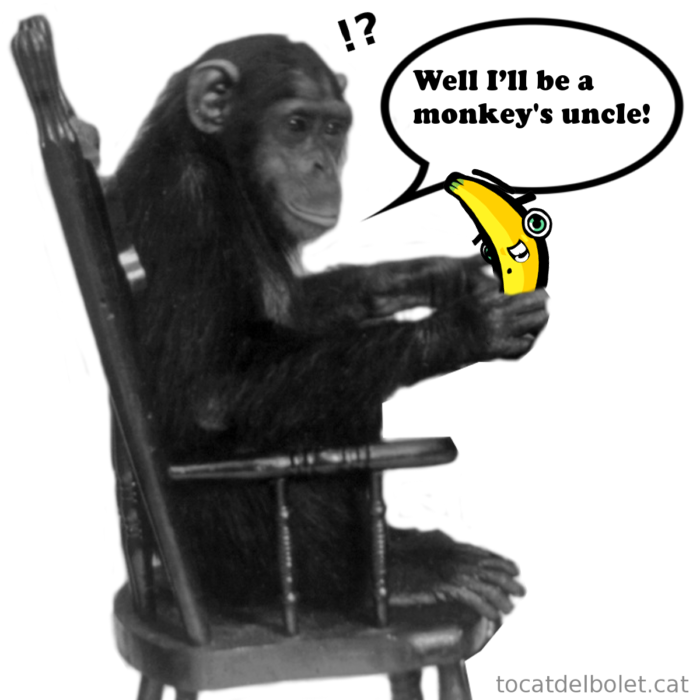
The idiom monkey’s uncle is used to express astonishment, complete surprise or disbelief. A synonymous expression is It’s beyond belief! It can also be used to point out the infeasability of a situation, in the same way that “when pigs fly” is used.
Example
— Hey dude, there is a news article about a dog reciting “To be or not to be”! — Well, I’ll be a monkey’s uncle!
“The government wants to improve public services,” said Boris. “Well I’ll be a monkey’s uncle,” said Jeremy, “didn’t they just slash the social services budget in half?”
I’ll be a monkey’s uncle in Catalan
There is a widespread idiom in Catalan which reads N’hi ha per a llogar-hi cadires! (literally, ‘We could even rent chairs!’) which is also used to express astonishment, complete surprise or disbelief. It can also be used to point out the infeasibility of a situation, in the same way that ‘(well) I’ll be a monkey’s uncle!’ is used in English.
I’ll be a monkey’s uncle in French
In French there are several equivalent expressionsto ‘(well) I’ll be a monkey’s uncle’ , for example, the most emblematic and international of all: ‘Oh la la!’ , which usually has rather positive connotations. There’s also C’est étonnant! (It’s incredible!), Je n’en reviens pas! (I can’t believe it!),J’en suis resté bouche bée (I’m speechless), Tu plaisantes! (literally, C’mon! You can’t be serious) … and one that we love: Mais qu’est ce que c’est que ça! (literally, ‘but what is it!’), Which usually has an angry connotation. Finally, we can also use the expression Mince alors (which has the approximate meaning of (upon) my word!).
I’ll be a monkey’s uncle in German
To express surprise in German, there is the curious idiom Ich glaub mich knutscht ein Elch! (Literally, I think an elk is kissing me!. And the interjection” Ach, nee! “(Literally,” Oh, come on!” ). * An elk is a ruminant mammal similar to a deer.
I’ll be a monkey’s uncle in Portuguese
In Portuguese, to express surprise in the face of something unexpected, there is a very curious expression, one of those idioms which translated literally sounds quite surrealistic: Macacos me mordam! (Literally, May macaques bite me!). Nevertheless, it uses monkeys, just like in English.
I’ll be a monkey’s uncle in Spanish
Here, surely, a never-ending debate could be opened, but the closest interjection to (Well) I’ll be a monkey’s uncle! in Spanish is ¡Lo que hay que ver! or Hay que ver! . There’s also ¡Madre mía! (literally My mother!) Since it can express surprise, disappointment or displeasure. Although in a more colloquial record, there is also another possibility that we particulary love: Cágate lorito! (literally, Shit yourself little parrot!) . In Spanish we would also have other expressions of surprise in the presence of something unexpected, such as ¡Que me parta un rayo! (literlly, May a beam break me in two!).
Nuts ~ Tocat del Bolet is a blog that aims to promote and share Catalan language and culture throughout its most typical expressions, in a fun and informative way.
Please feel free to leave any comment you like in the box below or to join our newsletter for updates.